Purpose To evaluate the association between lumbar lordosis and age using an AI-based automated measurement model applied to a large dataset of standing lateral spinal radiographs.
Materials and Methods This retrospective study analyzed 904 high-quality radiographs selected from 2,397 images acquired between 2019 and 2021. Lumbar lordosis was defined as the angle between the superior endplates of L1 and S1 and automatically measured using a validated deep learning model. Subjects were categorized into nine age groups. One-way ANOVA compared lumbar lordosis across age groups, and Pearson correlation assessed the relationship between age and lumbar lordosis.
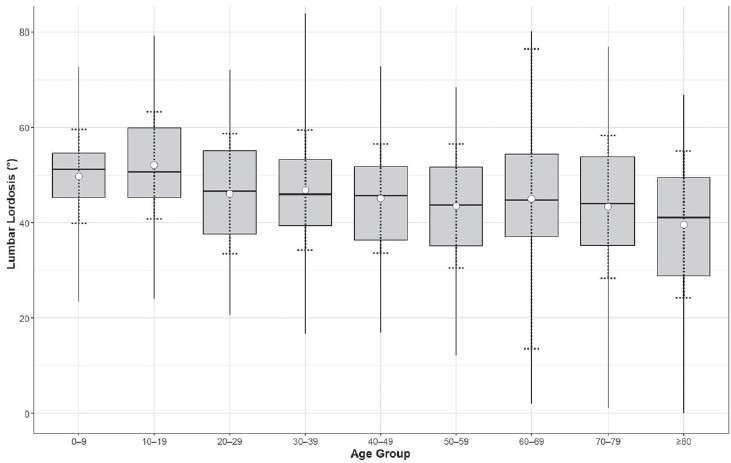
Results Lumbar lordosis ranged from 0° to 84° (mean 45.9°±13.4°). The highest mean value was in the 10–19-year group (52.1°), and the lowest in the ≥80-year group (39.6°). Minimum values decreased to 0° in individuals aged ≥60 years. No significant differences were found across age groups (p=0.561). A weak but significant negative correlation was observed between age and lumbar lordosis (r=–0.247, p<0.0001).
Conclusions AI-based automated measurement enabled efficient large-scale analysis and revealed a wide distribution of lumbar lordosis with a gradual age-related decline. These findings highlight the value of AI in spinal alignment assessment.
Purpose To develop and validate a deep learning–based artificial intelligence (AI) model for automated measurement of lumbar lordosis (LL) angles from whole spine lateral radiographs.
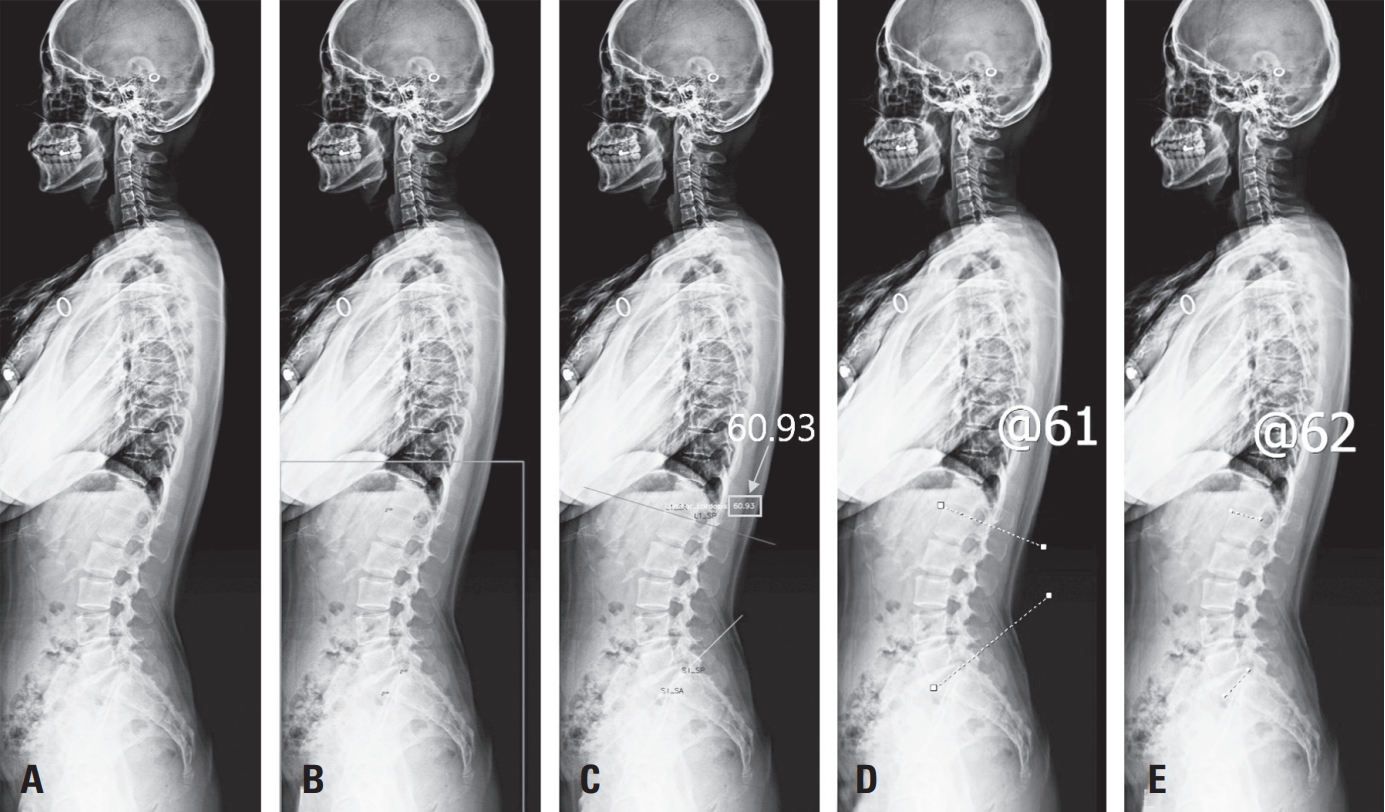
Materials and Methods A total of 888 lateral spine X-rays (2019–2021) were retrospectively collected and annotated with four anatomical keypoints (L1 and S1 vertebral landmarks). An AI model using Detectron2 with a Keypoint R-CNN and ResNeXt-101 backbone was trained with data augmentation. Performance was evaluated on 50 test images, comparing AI results to manual annotations by two orthopedic surgeons using intraclass correlation coefficient (ICC), Pearson’s correlation, and Bland–Altman analysis.
Results The model achieved an average precision of 71.63 for bounding boxes and 86.61 for keypoints. ICCs between AI and human raters ranged from 0.918 to 0.962. Pearson correlation coefficients were r=0.849 and r=0.903. Bland–Altman analysis showed minor underestimation biases (–3.42° and –4.28°) with acceptable agreement.
Conclusions The AI model showed excellent agreement with expert measurements and high reliability in LL angle assessment. Despite a slight underestimation, it offers a scalable, consistent tool for clinical use. Further studies should evaluate generalizability and interpretability in broader settings.
Citations
Citations to this article as recorded by
Deep Learning–based AI Analysis of the Correlation Between Lumbar Lordosis and Age Soo-Bin Lee, Ja-Yeong Yoon, Dong-Sik Chae, Sang-Bum Kim, Young-Seo Park, Kyung-Yil Kang, Min-Kyu Lee Journal of Advanced Spine Surgery.2025; 15(2): 78. CrossRef
Efficacy of Biportal Endoscopic Decompression for Lumbar Spinal Stenosis: A Meta-Analysis With Single-Arm Analysis and Comparative Analysis With Microscopic Decompression and Uniportal Endoscopic Decompression Shuangwen Lv, Haiwen Lv, Yupeng He, Xiansheng Xia Operative Neurosurgery.2024; 27(2): 158. CrossRef
Purpose Osteoporosis is an age-related systemic skeletal disease characterized by low bone mass and microarchitectural deterioration of bone contents, with a consequent increase in bone fragility. In severe osteoporosis progressive collapse of multiple vertebrae is and unsolved problem. Medical treatment appears to be too slow to prevent the course. Recently, there are some reports on the results of the percutaneous vertebroplasty (VP) in treating the multi-level osteoporotic vertebral compression fractures (VCFs). we reviewed painful multi-level osteoporotic VCFs treated by percutaneous VP and assess the efficacy and safety of multiple percutaneous cement VP in the treatment of multi-level osteoporotic VCFs.
Materials and Methods From January 2008 to August 2010, the clinical cases and radiographic records were reviewed retrospectively for 28 patients treated for the multi-level painful osteoporotic VCFs by percutaneous cement VP.
Initially radiography and MRI of the spine were performed. Spine radiographs were repeated at post-operation, 1,3 months and final follow-up. The patient’s outcomes of demographic, clinical, radiologic and procedural data were analyzed and assessed using self-report and physiological measures. A t-test was used for means of VAS, anterior vertebral height and kyphotic angle. Statistical analysis was performed with the SPSS(Version 15.0.1, Chicago, Illinois). The p-values of < 0.001 were deemed significant.
Results The back pain recorded using the VAS improved significantly in all cases, from 7.7±1.0(6-10), points preoperatively to 2.0±0.7(1-3) points postoperatively (p<0.001) and then 2.8±0.8(1-4) points at the follow-up (p<0.001).
The anterior heights increased from 17.40±4.98 to 21.02±5.36 after VP procedures (p<0.001) and finally 19.49±5.28 (p<0.001). The kyphotic angle was 12.58º preoperatively and improved to 4.39º postoperatively, but kyphotic deformities became worse in 12.80º.
Conclusion The vertebroplasty for patients with multiple osteoporotic vertebral compression fractures may improve pain and can be effective for preventing adjacent fractures, restoration of vertebral height and maintenance of sagittal alignment. Patients with multiple osteoporotic compression fractures have many comorbidity, the surgeon should be conscious to all procedure.



 First
First Prev
Prev