Chuck H. Lam, Halil Ibrahim Bulut, Conor T. Boylan, Max Moss, Momina Khan, Hassan Tahir, Prabhbir Devgun, Sourab Chand Surana, Pouyan Jafarian, Sleiman Haddad, David S. Marks, Jwalant Mehta, George McKay, Morgan Jones
Received January 17, 2026 Accepted May 7, 2026 Published online September 7, 2026
Adolescent idiopathic scoliosis (AIS) is the most common spinal deformity in adolescents, affecting individuals aged 10–16, with a multifactorial etiology involving genetic, hormonal, and biomechanical influences. This comprehensive literature review included 112 studies from journal conception to February 2025, retrieved from PubMed, Ovid MEDLINE, Scopus, and the Cochrane Library, focusing on epidemiology, pathophysiology, and treatment outcomes. AIS predominantly affects females, with a sex ratio increasing up to 7:1 in severe cases (>40° curves), and with right thoracic curves being the most common pattern. While bracing effectively prevents curve progression in moderate cases, spinal fusion remains the gold standard for severe deformities, ensuring long-term correction and preventing progression, despite a reduction in flexibility. Most adolescents return to full activities within a year postoperatively, with a low incidence of complications, including neurologic injury (~0.2%), infection (1%–5%), and pseudarthrosis (~1%). Future research will focus on optimizing non-fusion therapies, enhancing screening strategies, and integrating personalized medicine to improve patient outcomes and quality of life.
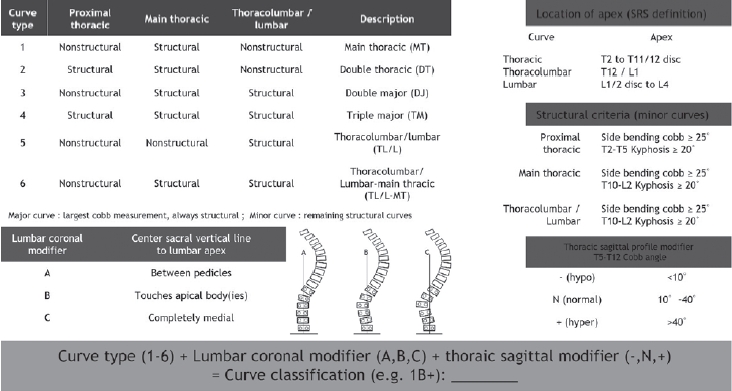
Adolescent idiopathic scoliosis refers to spinal deformity that develops from just before the onset of puberty until the completion of skeletal growth, and the primary goal of treatment is to achieve a well-balanced spine. In the late 1990s, advances in the anatomical understanding of the spine and the development of fixation instruments made posterior pedicle screw insertion feasible, thereby enabling the transmission of powerful corrective forces for deformity correction. Over the subsequent decades, accumulated clinical experience and outcomes have provided a deeper understanding of scoliotic curves and led to the establishment of effective principles for determining the extent of spinal fusion. However, these treatment principles are based on the unique biomechanics and procedural characteristics of scoliosis correction surgery, which can make them difficult to understand without sufficient explanation. In this review, we aim to describe these established treatment principles and surgical processes in detail using schematic illustrations and images. Although these principles will continue to undergo new challenges and validation over time, they will remain a meaningful reference point for those exploring alternative strategies.
Background Lumbar Arthroscopic Spinal Surgery (LASS) has several advantages compared to conventional procedures in terms of improved visual field, versatility with instrumentation, and ease of handling.
Purpose To report the learning curve of LASS for more than 10 years by an experienced spine surgeon.
Materials and Methods We retrospectively reviewed medical records of the patients who underwent LASS from Dec. 29th, 2017 to April 31st, 2018. Lumbar Arthroscopic Discectomy (LADi), Lumbar Arthroscopic Decompression (LAD), Lumbar Arthroscopic Foraminoplasty (LAF) were performed. Operation time, the amount of bleeding, the length of hospital stay and the degree of postoperative pain were analyzed to evaluate the learning curve.
Results 28 cases (90.3%) showed satisfactory postoperative results. The operation time per segment was 124.2±58.5 minutes (range 45~247). The mean operation time for LADi was 91.4±62.7 minutes (45~247), for LAD was 136.1±53.8 minutes (68~222 minutes) and for LAF was 135.3±50.6 minutes (72~245), and was indicating a declining trend. In the LAF, the slope of the decline of the learning curve was gentle compared to other operations.
Conclusion The results of short-term follow-up of LASS are excellent, and it is easy to acquire skills in experienced spine surgeon.


 First
First Prev
Prev